
Sergeant Lloyd Joseph Hopper
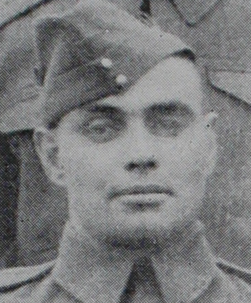
Lloyd Hopper was born on November 30, 1912 in Glencoe, Middlesex County, Ontario. According to the family, Nettie Hopper, Joseph’s mother, gave her husband, Joseph, $5.00 to register the birth, but he stopped at a tavern and used the money to buy a round of drinks to celebrate the birth of his son. Grandma Hopper was a formidable woman, so her husband never told her what he had done. The story never came to light until Lloyd needed a passport to go overseas and he did not have a birth certificate. He was eventually issued a passport after officers and Paris men attested to his identity. Prior to enlisting, the family lived at 51 Capron Street. Lloyd played hockey and was a keen bowler and fisherman. He worked at various jobs as a truck driver, electrician and plumber.
Lloyd enlisted with the 54th Battery in Brantford, on September 18, 1939, just prior to marrying Delphene Redfern on December 3, 1939 at St. Luke’s Rectory in Brantford. The marriage certificate was dated December 2 because they had to wait three days for the licence to be issued and Lloyd was to go overseas on December 6. It all worked out, Lloyd left with his unit on December 6, and Delphene would not see him again until the end of the war. (The photo, taken from a collage in the Brantford Expositor, shows Delphene seeing Lloyd off at the train station.)
The 54th Field Battery, Royal Canadian Horse Artillery, left Brantford by train on December 6 and arrived in Halifax on December 8. They were assigned to the Empress of Britain for the Atlantic crossing in Convoy TC-1. They disembarked on December 18, then journeyed and marched to the Leipzig Barracks in Aldershot, England, the primary Canadian Army camp. The unit trained on 18/25 pounder guns and once were inspected by the King and Queen. They sailed from Plymouth for France on June 11, 1940 and disembarked at Brest the next day.
The next week was chaotic because France was falling, the military situation was confused, and the town was filled with refugees. The original plans for the Regiment changed and it was finally recalled to defend Brest as other units were heading there for evacuation. Much military equipment was destroyed to keep it from falling into German hands. Fortunately, Brest did not come under intense attack like Dunkirk.
The 54th later took pride in being the only artillery unit to evacuate France with their guns, although trucks and tractors could not be loaded and had to be destroyed. No soldiers were left behind because of the guns. This was important later because so much equipment was lost in France during the evacuation that there were great fears that England did not have the arms to defend itself if the Germans carried through on their invasion plans.
In the end, the 54th spent a week in France in1940 but did not engage in a major battle with the Germans. There were a few casualties, mostly vehicle accidents.
After the fall of France in 1940, Lloyd was stationed with his unit at various camps in England. The postings were part of the Defence of Southern England strategy. They engaged in drilling, training, and war games over the next three years, with brief trips to Wales and Scotland for specialized exercises, until the invasion of Sicily in July 1943. The 54th Field Battery took part in the invasion of Sicily in 1943 and continued fighting in Italy throughout 1944. However, Lloyd did not go to Sicily. In January, 1943, he was assigned to the Records Section at the Canadian Military Headquarters in London where he remained until the end of the war.
Lloyd was promoted to Sergeant in May, 1945. He received the 1939-1945 Star, the Defence Medal 1945, the Canadian Volunteer Service Medal (with clasp), the War medal 1939-1945, and the Canada Efficiency Medal (with two rosettes). He was discharged on June 27, 1945.
After the war, Lloyd and Delphene purchased a house at 15 Amelia Street and raised their three children. Building materials and consumer items were in short supply following the war, but Lloyd found a toilet, sink, and bathtub on the “Paris black market”. Following the war, he joined the RCAF Ground Observer Corps. The organization relied on a network of volunteers (around 50,000) who were trained to spot and report enemy aircraft. The corps was established during the Cold War when there were fears of a Russian nuclear attack, before the northern radar lines were operational.
He took the risk of attack seriously. He poured extra-thick concrete walls in the basement of the house so it could be used as an improvised bomb shelter.
Following the war, Lloyd worked at Consolidated Sand and Gravel in Paris and as lead Hand at the Paris PUC Waterworks Division. Lloyd died in May, 1963 at the age of 50, as a result of the collapse of a trench, while he was in it, while working for the Town of Paris. Lloyd Hopper was a member of St James Anglican Church and the National Brotherhood of Electrical Workers, and a proud member of Royal Canadian Legion Branch #29.